
Why select LTE-M for large-scale IoT?
Author:深圳市磊科通科技有限公司
Click:
Time:2020-10-16 10:57:41
From:Telefonica UK

What are the network options?
A Low Power Wide Area Networks (LPWA or LPWAN) is a key enabler for connecting IoT devices and ensuring that they’re scalable. Why? Because these networks have been designed to allow long-range communications at a low bit rate among connected things. They draw less power, provide wider coverage and are significantly cheaper than traditional cellular devices.
These features make LPWAN ideal for IoT devices like asset tracking sensors. Businesses are likely to need a large number of them spread across far-flung locations. So sensors that only transfer low levels of data and don’t need to be charged make it easier to cover all assets.
In 2015, 3GPP (the technical standards body for
telecommunications) standardised two LPWA technologies
that are crucial for IoT. The first was LTE for Machines or
LTE-M (also known as eMTC or CAT- M1). The second was Narrowband IoT (NB-IoT).
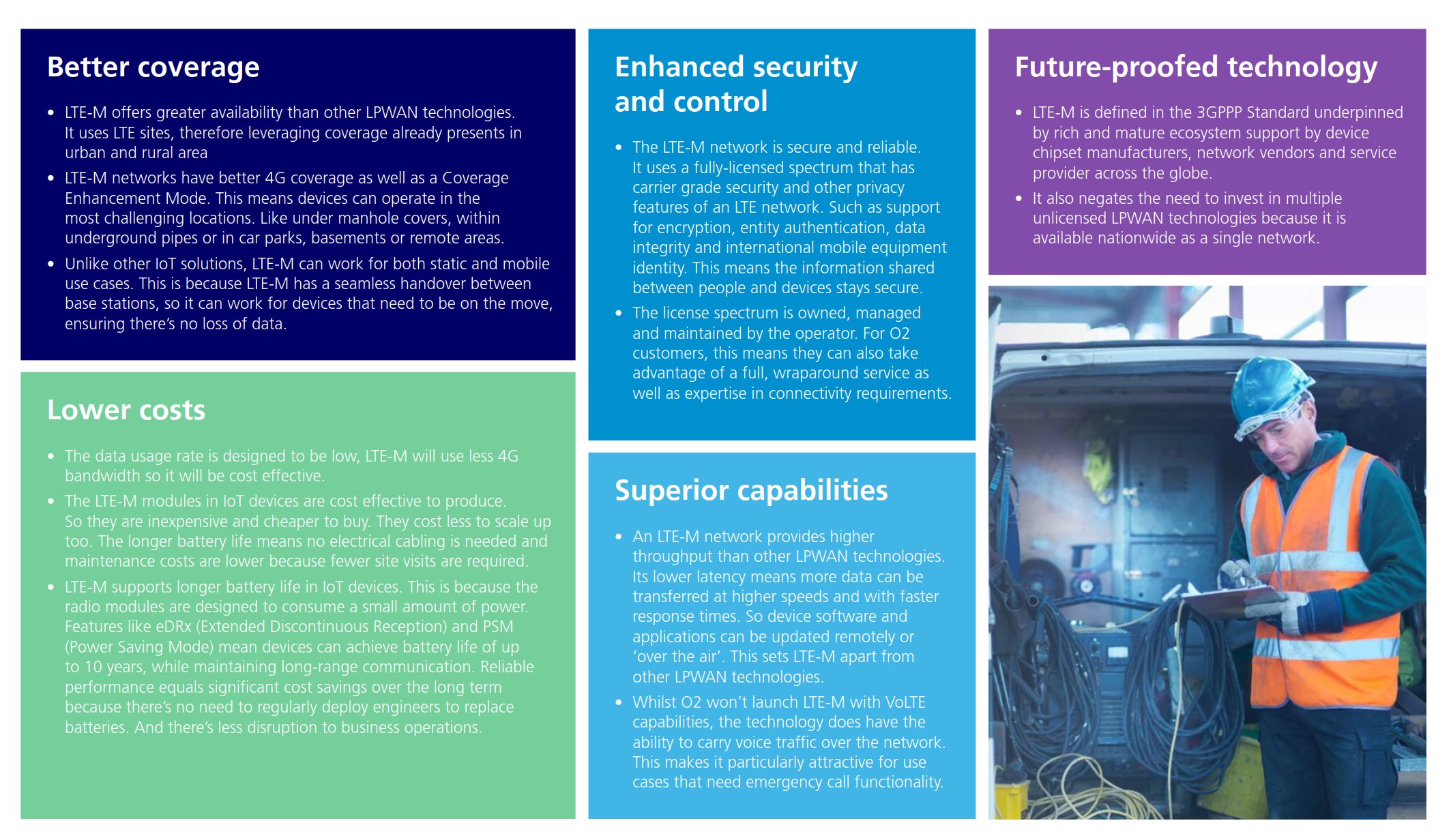
LTE-M is particularly unique, in that it provides higher throughput than any other LPWAN technologies. Its lower latency means more data can be transferred at higher speeds and with faster response times. So device software and applications can be updated remotely or ‘over the air’.This sets LTE-M apart from other LPWAN technologies.Some LTE-M networks also support VoLTE (although this is operator dependent), which makes it particularly attractivefor use cases that need emergency call functionality.
Both LTE-M and NB-IoT have their place in the market for different use cases. However, LTE-M offers the highest throughput, the highest bandwidth and the lowest latency out of the two technologies, making it ideal for many of the same use cases as NB-IoT, whilst also being more effective for applications such as smart grid, transport & logistics, home security, assisted living, retail, consumer devices & wearables.
In this way, LTE-M opens up the real possibility of connecting all kinds of assets through a single, secure and lasting solution. From shopping trolleys to fire alarms and shipping containers.
These use cases will empower organisations to work with greater operational efficiency. And because they can track and measure products, they can gain greater insight across their entire IoT portfolio.
That’s why LTE-M is predicted to be the network of choice for massive scale IoT deployment for UK businesses.
What is LTE-M and how does it work?
LTE-M is an upgrade to LTE (long term evolution/4G) networks. It’s a new radio technology that will enable millions of IoT devices to connect and transfer small amounts of data between them. At a low power rate over a unique and secure frequency.To do this, it uses existing 4G sites just like any other 4G devices would. It connects to 4G base station and packet core using using LTE-M bearer.
Thanks to its optimised design as standarised by 3GPP, LTE-M allows the battery in battery-operated devices to last up to10 years. This is achieved through a number of techniques such as reduced bandwidth equirement and removing unnecessary overhead.
As it uses the 4G network, LTE-M can provide connectivity to the most challenging locations. It operates in a rangeof up to 10km so can take advantage of prolific 4G coverage. This means businesses can connect IoT
devices in hard-to-reach locations.
The lower cost and higher coverage means LTE-M offers massive scalability. Management platforms provide extra flexibility and further reduce costs. They allow businesses to turn off any devices when they’re not in use so they only pay for the data they need.
Why do we need LTE-M?
The majority of legacy M2M and IoT solutions are using the 2G network. That’s because of the coverage and need to manage the power used by devices.
However, 4G networks are now the key network for mobile operators. Those operators are looking to deploy spectrumin the most efficient way for bandwidth. So the 2G spectrumis being re-farmed for use on 4G networks. While O2 has no active plans to retire its 2G network, LTE-M and NB-IoT are the natural successors to 2G. They’ve been specifically designed to meet the needs of M2M and IoT applications. As a result, these
networks will future-proof customer use cases.
LTE-M and NB-IoT are mature technologies and well suited to address wide range of M2M and IoT use cases. That’s down to the coverage required by most large-scale use cases. 3GPP is investigating the options for 5G core network support for LTE-M and NB-IoT. This will ensure a smooth operator migration path to 5G while preserving LTE-M and NB-IoT deployments in the future. But this is still in its infancy. So LTE-M on 4G networks will continue to offer the best coverage and the lowest costs for the next decade.
What are the key benefits of LTE-M?
What are the use cases for LTE-M?
The use cases for LTE-M stretch far and wide. They touch most industries. From agriculture to zoology. The following examples highlight some of the ways that LTE-M could transform the way we live, play and work. Simply by making our lives smarter and more efficient.
Utilities
IoT-based smart meters provide end consumers with added value services like direct information on energy consumption and offer access to flexible tariffs. Sensors that monitor infrastructure could improve industry efficiencies. They could also prevent faults and help fix them faster when they do occur. The lower power use and national coverage of LTE-M allows utilities to rapidly take advantage of cheaper IoT devices and
use the data to improve margins.
LTE-M in action
Las Vegas Valley Water District supplies 7.5m gallons water per day to the city. Aging infrastructure installed in the 50s and 60s is prone to leakage and small leaks eventually create sinkholes, which costs the city millions of dollars. Critical pipelines are now monitored by thousands of permanent acoustic sensors, searching for leaks. Leaks are detected faster and can be fixed before major problems occur.

Logistics
IoT makes tracking logistical assets easier. For example, a
shipping container full of edibles could be tracked as it left port, across the seas and right up to its final destination. This would provide valuable information if it was re-routed or held up for congestion. Any issues could be addresses straightaway instead of days or weeks later. LTE-M works particularly well for mobile asset tracking because it allows IoT devices ton run without mains power.


Industrial/Manufacturing
The use of IoT devices can improve the safety and efficiency of industrial production. Sensors can monitor dangerous liquids and gases in tanks, including the correct level, temperature or pressure. Or they could produce automated reports on what needs to be refilled in individual vending machines to reduce the need for costly regular visits.

Smart cities
Smart Cities are dependent on the mass uptake of IoT devices. Car park sensors will show people where there’s a free spaceto park. They can also improve pricing data and safety. Smart street lights can be managed remotely to cut costs and improve citizens quality of life. Lights could be dimmed or turned off when no one is around or brightened in areas with high crime and to support emergency response teams. LTE-M can speed up the creation of Smart Cities because the network infrastructure is already present in urban areas.

Agriculture and environment
Several IoT use cases can drive efficiency and improve safety improvements. Farmers can track and monitor their cattle remotely Environmental agencies can analyse water levels, predict flooding and issue early warnings to the most likely affected people and businesses. LTE-M provides the required mobility, rural coverage and reliability to support such use cases.
LTE-M in action
KDDI is currently using LTE-M connectivity to provide information about Mount Fuji in real time. The solution
enables nearby authorities to use a web portal to track critical information such as seismologic, temperatures and humidity levels; LTE-M provides the information in real time, from various challenging locations that cannot be easily reached, hence requiring real time monitoring and no device maintenance.

Consumer and medical
Wearable IoT devices like wristbands or heart monitors can improve people’s health and safety in the home or at work. Trackers can help parents monitor where children are. Smart devices can also let elderly people notify someone if they’ve had a fall. Reducing the time between the problem emerging and help arriving prevents significant effects on health, reduces anxiety and cuts the costs of treatment. LTE-M offers the
mobile and VoLTE emergency call capabilities to support the widespread use of such monitoring devices.

Smart buildings
Just like Smart Cities, Smart Buildings rely on a network of connected devices. They are particularly important for automated health and safety applications. Like smoke detectors that can test themselves and auto alert the relevant parties in case of a fire.
LTE-M in action
Igloohome and SingTel use LTE-M to connect digital locks that enable smart access to properties and infrastructure assets, remotely controlling access to different sites and monitoring real time who has entered and left a building.


Prev : Industrial Internet Solution StudyNext : Kotonlink: Visualized Surveillance Solution for Logistic Fleet
文章推荐

